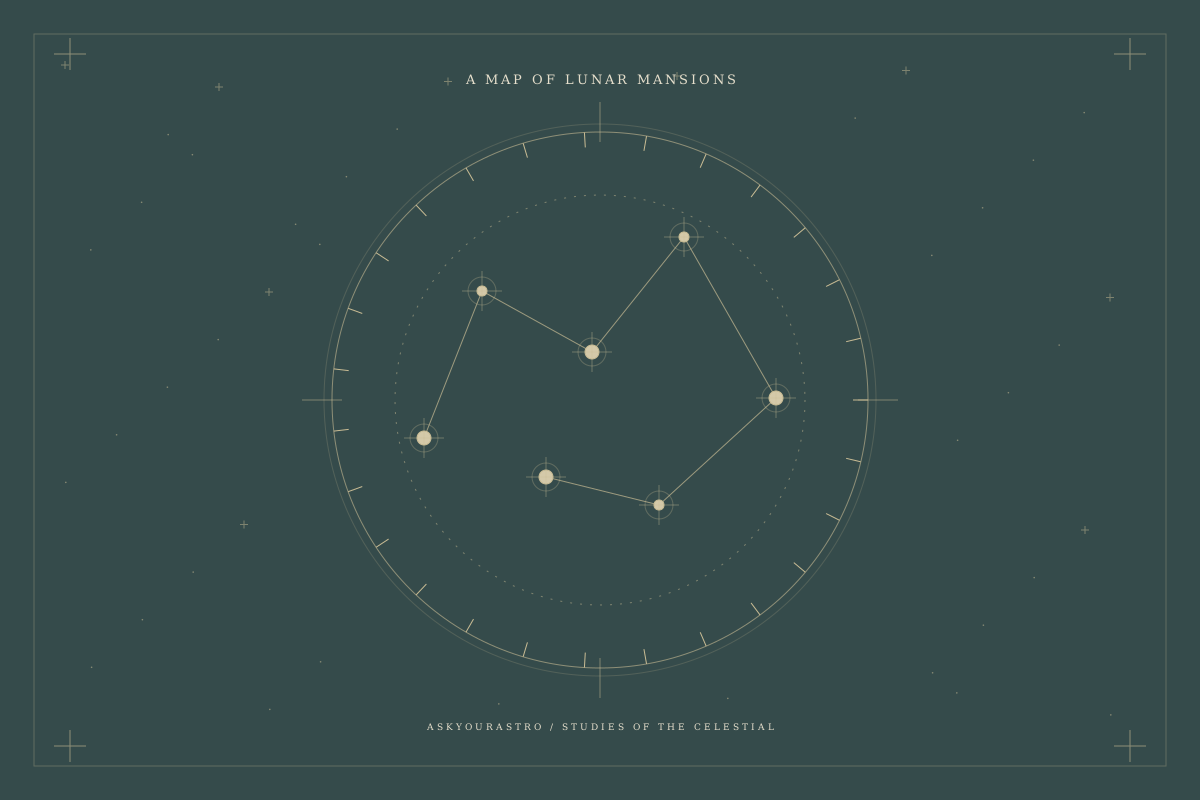
Nakshatras add a finer division to the zodiac used in many Vedic astrology traditions. The word is often translated as lunar mansion. In the common twenty-seven-part system, each division spans thirteen degrees and twenty arcminutes of zodiacal longitude.
This is a different framework from the twelve signs. Knowing the difference makes chart terminology much easier to follow.
A second way to divide the zodiac
The twelve signs each span thirty degrees. Twenty-seven equal nakshatra divisions cover that same circle using a different scale. A planet can therefore be described by both a sign and a nakshatra.
Some historical and specialized contexts also refer to Abhijit and a twenty-eight-nakshatra arrangement. If a source uses a different count, identify its context rather than combining its system with a standard chart table without explanation.
Why the Moon receives attention
The Moon’s birth nakshatra is especially prominent in many introductory Vedic readings. It is often called the janma nakshatra. It is a position calculated from the Moon’s longitude, not a personality test.
Because the Moon moves across the zodiac, time uncertainty can matter near a boundary. If your chart tool gives the Moon’s degrees, compare those with the nakshatra table and the chosen ayanamsha. Avoid relying on a name alone when two calculations appear to disagree.
What a pada means
Each nakshatra is commonly divided into four quarters, called padas. A quarter spans three degrees and twenty arcminutes. These subdivisions are used in further interpretive techniques and in relationships with divisional-chart conventions.
At the beginning, it is enough to understand that a pada is a subdivision. You do not need to memorize every association before learning how the larger chart is organized.
Symbols belong to a tradition
Nakshatras are associated with names, symbols, deities, and interpretive themes. Different texts and teachers emphasize different aspects. Read those associations within their cultural setting, and ask the author to distinguish a textual tradition from a personal interpretation.
Descriptions that reduce an entire person to one nakshatra miss the rest of the chart and the person’s actual circumstances. They are particularly unhelpful when used to judge compatibility, character, or mental health.
The connection with timing
The widely used Vimshottari dasha system draws on the Moon’s birth nakshatra and its position within that division. This is one reason accurate calculation settings matter before a timing sequence is discussed.
Our dasha introduction separates period calculation from predictions about what a period might mean. That distinction is worth keeping whenever a precise date appears in an astrology report.
A small study exercise
Use a sample chart to record the Moon’s sign, longitude, nakshatra, and pada. Check that all four labels come from the same calculation settings. Then return to Sun, Moon, and rising signs to place the lunar details in a wider context.
You are learning a symbolic classification system. A detailed classification can be interesting without proving that it determines someone’s future.
TAKE THE NEXT STEP
Bring your questions with you.
Learn about AstroSaathi’s Android project and its approach to personal astrology conversations.
Explore AstroSaathi