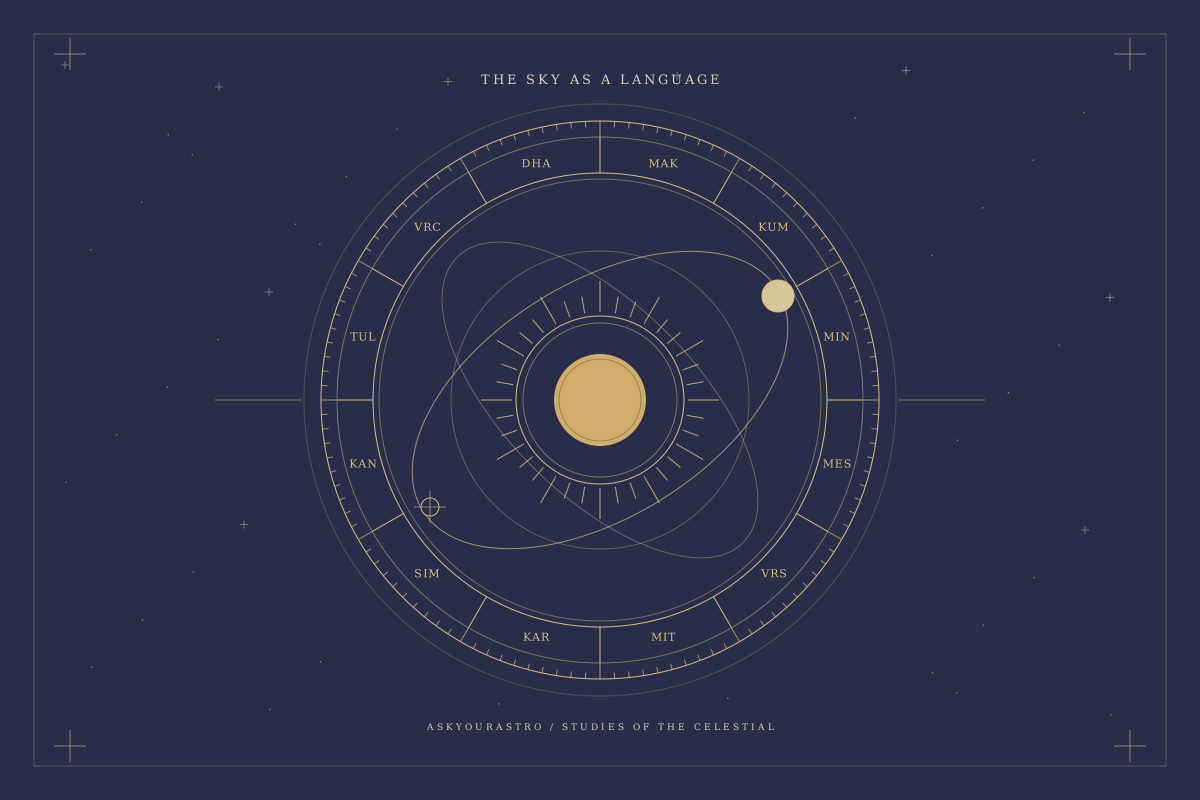
A chart diagram can look crowded before you know its conventions. Numbers may represent signs rather than houses, a symbol may identify the ascendant, and the same planetary data can appear in very different layouts. Your first job is to establish how the diagram works.
You do not need to predict anything to learn this skill. Reading the notation is useful on its own.
Check the birth information first
Start with the date, time, and place entered into the chart tool. Confirm the date format, local time, and whether the birth location has been matched correctly. Historical time-zone and daylight-saving rules can matter; they should be handled by a reliable calculation system rather than guessed from today’s clock offset.
Record whether the birth time is documented or approximate. Uncertainty can affect the ascendant and house positions, and some finer divisions can be particularly sensitive. Do not invent an exact minute to make a form accept an answer.
Identify the layout
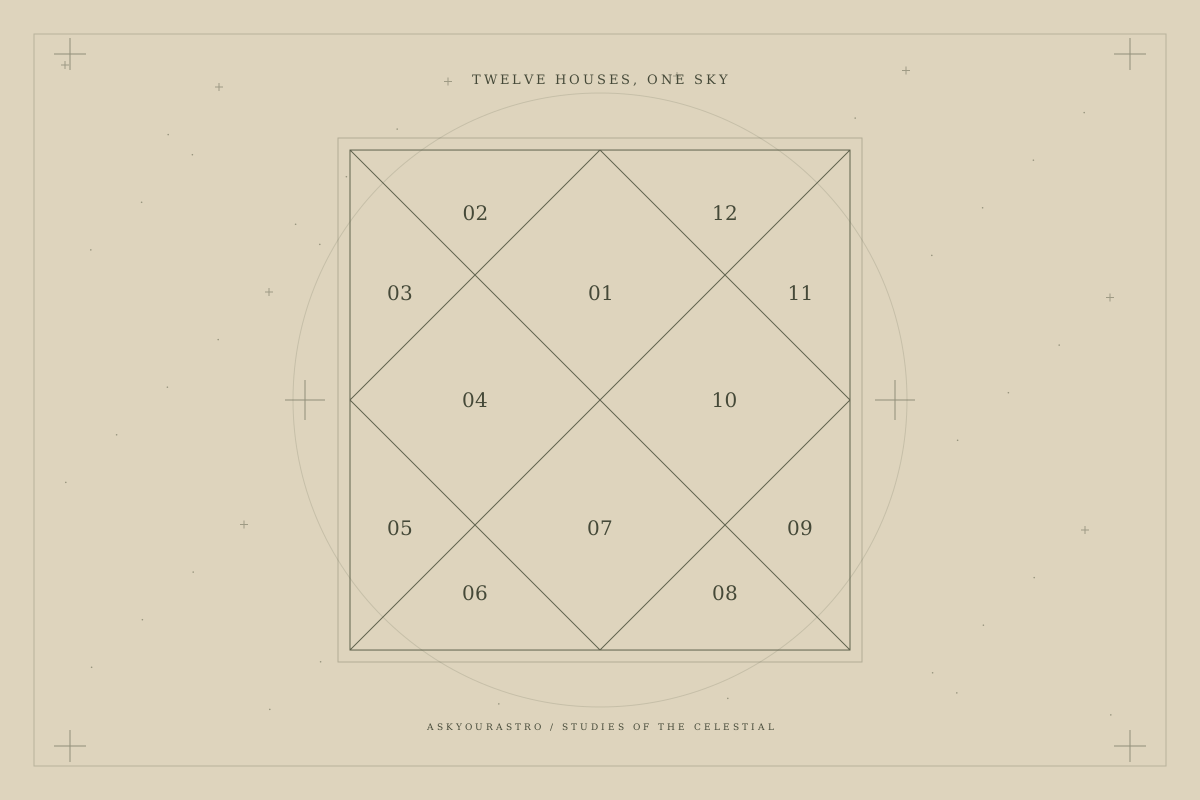
Common Indian chart styles include North Indian and South Indian layouts. Their visual conventions differ. In a typical North Indian chart, the house positions remain fixed in the diagram while sign numbers change. In a typical South Indian chart, the sign positions remain fixed and the ascendant marks the starting house.
Look for a legend from the chart provider. The numeral “1” might mean Mesha, the first zodiac sign, rather than the first house. Confusing those meanings can make every later step misleading.
Find the ascendant
The ascendant, or lagna, is the point of the zodiac rising on the eastern horizon at the given time and place. It helps orient the houses in the chart. Locate its marker and check the corresponding sign before following the house sequence.
If the diagram and an accompanying table seem inconsistent, use the provider’s notation guide. Do not assume that every chart image follows the same visual order.
Separate signs from houses
Write down a simple inventory: ascendant sign, Moon sign, and the sign and house shown for each planet. This is a description of the chart. It is separate from interpreting the symbols.
A sign describes one zodiac section; a house describes a chart division associated with life topics. You can learn more in our guide to the twelve houses. Avoid reducing a placement to a single adjective before understanding both layers.
Read combinations with care
Traditional interpretation considers relationships among placements, not just isolated symbols. Practitioners may examine aspects, house rulership, dignities, and other conventions. These techniques vary by school, so explanations should identify the method they use.
An alarming statement about one placement is a reason to ask for context. A diagram does not justify certainty about a person’s health, relationship, or financial future.
Keep a useful chart notebook
For a first session, keep four things together:
- Your birth information and its source.
- The calculation settings, including zodiac and ayanamsha.
- A short list of placements you can identify directly.
- Questions about anything that remains unclear.
Return to the Vedic astrology introduction whenever the vocabulary becomes distracting. Learning a chart’s structure slowly is more useful than collecting confident predictions without understanding how they were reached.
TAKE THE NEXT STEP
Bring your questions with you.
Learn about AstroSaathi’s Android project and its approach to personal astrology conversations.
Explore AstroSaathi