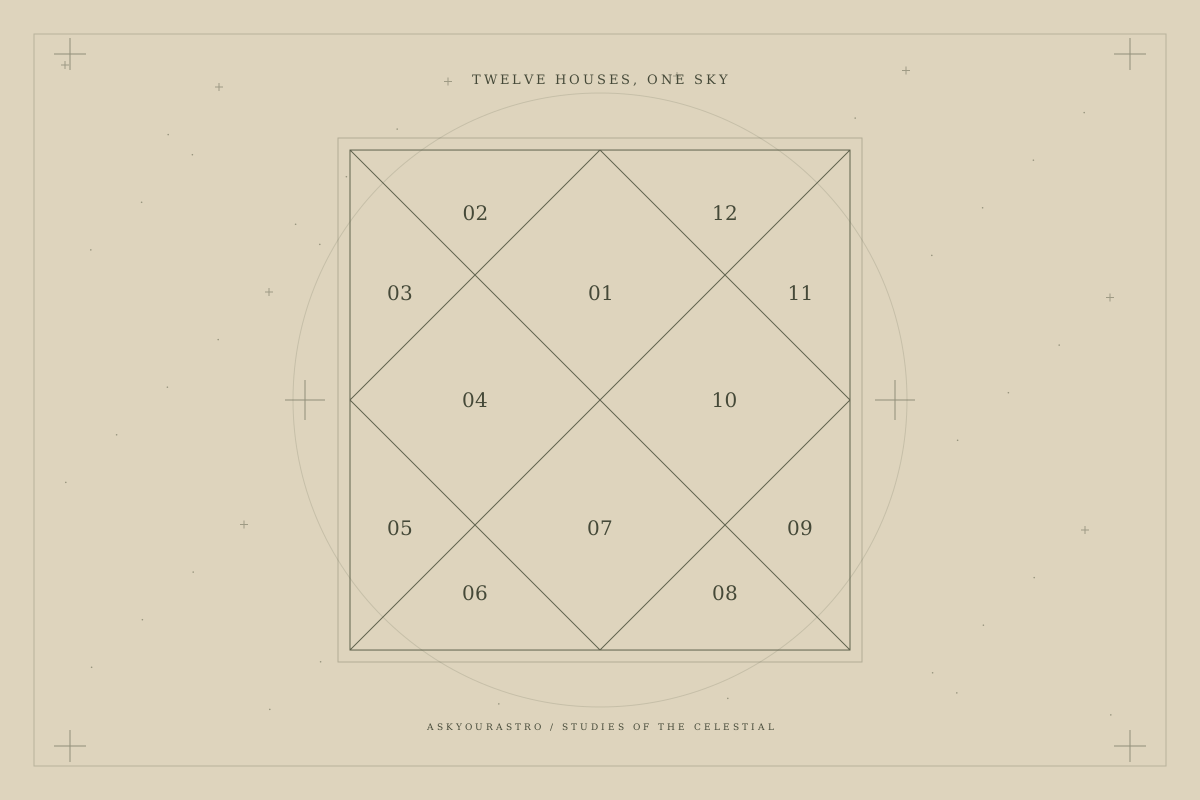
The twelve houses organize a birth chart into traditional areas of experience. They are often introduced through short keywords: home, work, relationships. Those keywords can be helpful, but they are only entry points into a much more detailed interpretive tradition.
Before looking up a house meaning, make sure you know whether the number in your chart refers to a house or a sign. Our birth-chart reading guide explains that distinction.
Houses are not zodiac signs
Signs divide the zodiac into twelve equal sections. Houses relate the chart to its orientation for a time and place. Many introductory Vedic readings use whole-sign houses, but other approaches to house divisions also exist.
For that reason, two tools can display house information differently while showing similar planetary longitudes. Check the calculation method before comparing house placements.
The first six houses
The following are broad traditional themes, rather than predictions:
| House | Common introductory themes |
|---|---|
| First | Embodiment, identity, approach to life |
| Second | Resources, speech, family context |
| Third | Initiative, skills, siblings, communication |
| Fourth | Home, belonging, private life |
| Fifth | Creativity, learning, children |
| Sixth | Service, routines, disputes, difficulties |
These associations are not exclusive. A topic such as education may involve several houses, planetary relationships, and the interpretive school being followed. A single keyword does not establish how something will unfold.
The seventh through twelfth houses
| House | Common introductory themes |
|---|---|
| Seventh | Partnership, agreements, encounters with others |
| Eighth | Shared resources, vulnerability, change |
| Ninth | Beliefs, teachers, tradition, long journeys |
| Tenth | Work, public activity, responsibility |
| Eleventh | Networks, aspirations, gains |
| Twelfth | Retreat, expenditure, release, seclusion |
Some of these houses attract dramatic online descriptions. Be careful with claims that turn a symbolic association into a diagnosis, threat, or unavoidable event. Traditional language often needs explanation in its historical context.
An empty house is still a house
A house without a planet does not mean that its themes are missing from your life. Traditional readings may consider the house’s sign, its ruler, aspects, and the rest of the chart. The absence of a visible planetary symbol is simply one piece of the diagram.
Similarly, several planets in a house do not automatically make that topic more successful or more difficult. Reading combinations requires a stated method and the surrounding context.
A practical way to study
Choose one house and compare how two introductory sources explain it. Separate their shared vocabulary from their interpretive claims. Then locate that house in a sample chart without trying to infer a person’s future.
Build a small glossary rather than a list of good and bad placements. The goal is to become more precise about what you are reading. Revisit the foundations of Vedic astrology when you need the wider picture.
Houses can provide an interesting vocabulary for reflection. They should not decide medical care, relationships, or financial commitments on your behalf.
TAKE THE NEXT STEP
Bring your questions with you.
Learn about AstroSaathi’s Android project and its approach to personal astrology conversations.
Explore AstroSaathi